A Brief History of the London Transport Old Comrades Association
The Association welcomes members from the ex-services, men and women who are currently employed by, or have retired from, London's public
transport system. These include Transport for London and London Underground staff, together with those buses and engineering members whose companies have been privatised.
The origins of the Association go back to the First World War, following the illustrious record of London Busmen who took their "B" type buses to Flanders to ferry troops to and from the front lines, and bring wounded back. King George V proclaimed in 1920, that London Busmen would parade at the Cenotaph on Remembrance Sunday. This proud tradition has been maintained every year. Later, following the Second World War, London Underground and other sections of London Transport volunteered ex-servicemen to join the Busmen on the parade. These marchers eventually formed their own Armistice Association and held a lunch each year to foster comradeship and to discuss aspects of the Parade.
In 1923 Admin Staff who had returned from the War formed the London Transport Old Comrades Association and were later also invited to march. Its main purpose was to hold an annual dinner on the Friday evening before the Remembrance Day service at the Cenotaph as close to the 11th November as possible.
Today the Busmen, Underground Staff and Old Comrades make up what is known as “The Transport for London Contingent” of the parade. Since the privatisation of the bus side of London Transport, busmen in the contingent were mostly Retired Staff and consequently reducing in numbers as the year’s progress. With this in mind the association have opened up the membership to all eligible staff
In 1996, following discussions with London Transport senior staff, it was agreed to amalgamate the two Associations with the following objectives.
1. To foster comradeship among ex-service men and women, working for, or retired from London Transport now Transport for London.
2. To hold an informal lunch once a year to thank those members who represented TfL at the Cenotaph, usually in the spring, and a Formal dinner prior to the Remembrance Day Parade in November each year.
3. To consult with Transport for London on all aspects of the Parade, Including wreath laying, catering facilities and accommodation at Broadway. It should be noted that senior staff of Transport for London have always provided active support and financial help, without which we would find it difficult to continue.
2. To hold an informal lunch once a year to thank those members who represented TfL at the Cenotaph, usually in the spring, and a Formal dinner prior to the Remembrance Day Parade in November each year.
3. To consult with Transport for London on all aspects of the Parade, Including wreath laying, catering facilities and accommodation at Broadway. It should be noted that senior staff of Transport for London have always provided active support and financial help, without which we would find it difficult to continue.
Since November 1998 the Association has also had a plot at the Field of Remembrance, Westminster Abbey. Members are encouraged to meet there each year at 10:00hrs, on the Thursday before the Remembrance Day Parade, where a member of the Royal Family attends, to pay tribute to the various Regiments and Organisations who present plots in memory of their respective fallen.
The association have always been told that our contingent was the first non-military group to march at the cenotaph, the documents however indicate that although the busmen were volunteers they were in fact enlisted into the forces before going to France. This fact is borne out by one of our members whose wife’s Grandfather was one of the 330 busmen who volunteered to go to France and they have his forces paper work.
As the London General Omnibus Company was the main provider of the 330 the association have researched its origins and found out that prior to the 1st world war is was purchased by the Underground Company which also had 3 of the tube railways in its portfolio. This would suggest this is how when Transport in London was nationalised they gained the name of London Transport.
As the London General Omnibus Company was the main provider of the 330 the association have researched its origins and found out that prior to the 1st world war is was purchased by the Underground Company which also had 3 of the tube railways in its portfolio. This would suggest this is how when Transport in London was nationalised they gained the name of London Transport.
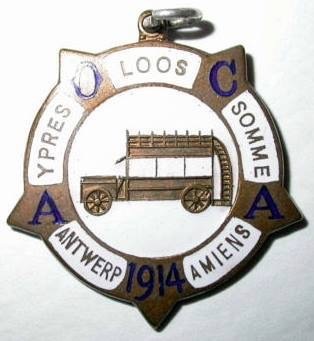
London Transport Old Comrades AssociationBackground Brief
In 1920, King George V granted a unique honour to the London General Omnibus Company – that was eventually to become part of London Buses and the forerunner of today’s Transport for London. This honour established London Transport as the only civilian organisation to march alongside the armed forces in the Remembrance Day Parade. The honour was in recognition of the service rendered by the men of the London General Omnibus Company who served as soldiers and drove their buses, carrying troops and equipment, to and from the front line in France during World War 1. Although changes have taken place over the years London Transport maintain the privileged position of ‘last in line’ on Remembrance Day and ‘first in line’ at the Cenotaph.
In 1919, George Gwynn a driver in the Merton garage wrote;
“I left on 22 October 1914 with the very same bus (B1219) as had been on service between Raynes Park and Liverpool Street. She has done good work, taking part in the First and Second Battles of Ypres, the Battle of La Bassee, the Battle of Neuve-Chapelle and the Battle of Loos, did her bit in our Somme offensive, and again at the Battle of Arras, at Cambrai, and also at Messines Ridge. Then again she did some good work in rushing reinforcements up to Bailleul…and then loaded with some of our brave troops to Mons”.
In addition to the those from London Transport who made the ultimate sacrifice in both World Wars, there were many who served in both conflicts or have seen active service in the various emergencies or theatres of war that have arisen since WW2, including the more recent events in Europe, the Middle East and Asia.
London Transport also played a significant role on the home front during WW2, supporting the fire services, as part of the Home Guard and ARP and providing essential transport services. Throughout the Blitz on London, underground stations provided shelter and facilities in 86 medical posts for over 63 million users. In excess of 7 tons of food and 12,000 gallons of tea and cocoa were carried on specially converted refreshment trains every day to support those being sheltered.
A little-known aspect is that, throughout WW2, the LT Works at Chiswick constructed a significant number of Halifax bombers that were ultimately to play an important role in the destruction of German wartime industry. Between 1941 and April 1945 over 700 were constructed using 500 different sub-contractors. The nucleus of the organisation was established at Chiswick, then developed out to Aldenham before taking over a new factory at Leavesdon. The organisation assumed responsibility for final erection, test flying and delivery of complete aircraft. The 710th aircraft off production was called “London Pride”.
Also a closely guarded secret was the provision of a 5 mile tunnel, 4 yards in diameter, and situated under 3 stations at Wanstead, Redbridge and Gants Hill, providing 300,000 square feet of factory space for the production of aircraft parts together with a subterranean canteen for 600 people and 4 mess rooms seating 1600, with additional entries at Cambridge Park and Daneshurst Gardens (No employee in the factory had more than 400 yards to walk to the place of work, an important aspect during the Blitz!). The two-mile tunnel between Leytonstone and Newbury Park was converted into a secret artillery factory whilst Goodge Street once formed part of General Eisenhower’s command centre. Other elements included the tunnels between Holborn and Aldwych which were used to house many of the priceless objects from London’s museums.
London Transport staff also contributed to a LT fund dedicated to paying for the production of Spitfire fighters, two of which carried the London Transport logo on the side of the aircraft and flew with 308 and 350 Squadrons
The objects of the London Transport Old Comrades Association are to perpetuate the memory of those who made the supreme sacrifice in the service of their country and to preserve the spirit of comradeship among all ex-service personnel. These objects are achieved through participation in the march to the Cenotaph on Armistice Sunday, attendance at the Field of Remembrance and at LT’s own memorial in Broadway, and the holding of a reunion dinner on the Friday preceding Remembrance Sunday. Many of our members also make the pilgrimage to the battlefields and to the services at the Menin Gate and the Dunkirk beaches.
However, the Association is also involved in several other activities throughout the year ranging from assistance to old comrades, supporting charities, reunion luncheons, visits to many battlefield sites, and links to other service/ex-service associations.
As the years progress it becomes more difficult to retain the direct links through our older members. We have in the past invited representatives from the Chelsea Pensioners to ensure that these links can be maintained as long as possible. Nevertheless, there are a growing number of new veterans arising from the many peacekeeping operations involving British servicemen and women around the globe. Indeed, there are a few Territorials within our organisation who have been actively involved in Afghanistan, Kosova and Iraq.
Transport for London - LT Museum - B&W Photos
Images 2007/3875 ; 2006/1233 ; 2005/19317 ‘Image form the London Transport Museum collection’
All other Images
2007/10533 ; 2007/10530 ;1998/16034 ; 2004/8817 ; 2007/10528 ; 1998/16043 ; 1998/16041 ;
1998 / 39027 ; 1998 / 57463 ; 1998 / 36610 ; 1998 / 78429 ; 2007 / 10531.
'© TfL from the London Transport Museum collection'